
Lipstick On A Pig
Carceral humanism or business as usual?

Martin is not dead.
Martin is not dead, but I am crying.
I am crying because Martin is a real person and he is my friend. Just because he is incarcerated doesn’t mean he isn’t a human being with hopes and dreams, mistakes and shame.
Just like me.
I wrote about Martin’s refusal to be transferred and then going on hunger strike in my “Not Playing Their Game” post of February 9, 2026.
The very next week, he was beaten by guards to within an inch of his life.
Why? Because he refused to play their game. Remember, he is 80 years old and has been down 56 years. He is a tall, quiet, refined Black gentleman whose spiritual depth and compassionate heart were legion among our sangha members. He always came to sit in peace; he rarely spoke, and only did so toward the end of his time at this prison to make a comment or two about the value of inner silence.
Martin refused to get shipped off to a new environment far from comfort and familiarity—something always difficult even for youngsters. And so he was sent to the hole, aka solitary confinement, aka restrictive housing. This was an administrative decision, not for a crime committed. It meant Martin was reclassified as a “program failure” and stripped of privileges that defined his dignity, his humanity and his voice. For exercising his human right to say “No, I won’t go.” For seeking to preserve some measure of control over his housing situation and his wellbeing, as he already has chronic medical conditions.
Yet correctional officers pulled him out last week, in cuffs, an excessive use of force. So in an uncharacteristic but purposeful act, Martin attacked them. He knew what he was doing; it was likely attempted suicide, since the week before he had told our sangha, “You won’t see me again.”
A deliberate act indeed. But I don’t think he counted on being so severely beaten as to wind up hospitalized outside the walls on life support. And in restraints. And then transferred anyway, against his will and his heart.
I keep checking the “inmate locator” and see that Martin did not die, but has been transferred to a Corrections health care facility in central California. He was not returned to our prison. And this new institution? It “provides medical care and mental health treatment to incarcerated people who have the most severe and long term needs,” nearly 3,000 men of all security levels spread over 1.4 million square feet.
In other words, Martin likely was maimed, irrevocably.
This facility’s website assures dear taxpayers that they provide services efficiently, safely, and cost effectively. The health care CEO’s bio also assures that he, this one who holds a graduate degree in industrial engineering, “strongly believes in strong teams that innovate using lean methodologies to implement and execute a robust prescriptive analytical method that can answer real time solutions to some of the most complex data questions in healthcare.”
OK well that’s nice and wordy, but how does he actually CARE for his wards?
Because they are so much more than numbers, more than data questions: They are human beings.
Human fucking beings.
And Martin is one of the best I’d ever met inside the walls.
I bring this story not just to update you, but to juxtapose his situation, which would never get public attention, with the one that did, at the same time: The celebration, governor and all, of the completion of the San Quentin Learning Center.
SQ is no longer labeled a prison; it is now a rehabilitation center. The Department, with legislative approval, has spent nearly $250 million in taxpayer dollars on an 80,000 square foot project that triples classroom space, provides new rehabilitative areas, and sports a one-stop reentry program. This is the new “California Model,” modeled after Norway’s successful lifestyle incarceration that humanizes their wards by keeping them involved in their community rather than isolating them behind cement walls and electrified wire. Staff is trained in compassion and communication, inmates cook their own meals and wear their own clothes, and at the lowest security levels ride their bicycles to work.
The new SQ campus features an on-site café that’s the brainchild of incarcerated activists there—a population that originally was not even included as a stakeholder in this new carceral venture. There’s also a sparkling new media center with real-world A/V space.
The idea is that rehabilitation and public safety go hand in hand—and yes, they do. And it’s right that the Department is spending, at long last, big funds on rehabilitation: The “R” in CDCR was added only in 2006, after decades with endless punishment as the focal point, promoting the idea of that rehabilitation would reduce recidivism. (Of course it does!)
But one irony is this: Most rehabilitative programming is not only volunteer based, not Corrections funded; but the most and best are available primarily at lower custody levels. When in fact it is the most violent and troubled population, those at high security prisons, who need such programming the most.
The other irony is that all this money is being spent on only a fraction of California’s incarcerated population of about 90,000. Even at SQ, men have to be approved for this new program; it isn’t available to everyone housed there. SQ has always had famous and robust programming because of its location in the heart of the San Francisco Bay Area, where there’s enough volunteers and enough money to operate hundreds of rehabilitative programs that supplement what taxpayer dollars fund through CDCR’s vocational and educational programs.
Too many of the other 30+ prisons in California’s systems are deliberately isolated, whether in the far north of the state, in the dangerously dusty Central Valley, or in the despicably infernal facilities in the far southeast corner of the state where the populations do not benefit from Bay views and ocean breezes or even get promised ice.
Fact: Rehabilitation succeeds when there is buy-in not only from inmates but especially from custody and administrative staff. And that is not always the case in California’s carceral landscape—not by a long shot. Custody is made up of many officers from the same hoods and the same traumas, the same racial distrust and the same fighting mentality. They often have no more than a GED yet can make six figures with overtime nearly straight out of academy. Officer misconduct has been the subject of many a tale, including sponsored “gladiator fights” (my ex had to participate in those) and selling contraband (drugs, cellphones) that the IPs then get written up and punished for.
And so I’m reading a letter in the All Of Us Or None newspaper from an artist currently incarcerated at Pelican Bay, the supermax I’ve often written about. It was the original site of three statewide hunger strikes in 2011 and 2013 called (legally) by men who had been held in isolation for decades on gang validations—peaceful protests that in 2015 resulted in their victorious, landmark class action against the Department for having violated due process and cruel and unusual punishment Amendments. More than 1500 men who had done 10 to 42 years in solitary confinement were released to general population.
My ex was the 79th longest held, at 21 windowless, contactless, humaneless years.
The California Model would not have happened without their sacrifice and their truth-telling about appalling, torturous conditions of incarceration—conditions inherent in a prison industrial complex that the rest of the country is currently, finally, learning about in ICE detention centers.
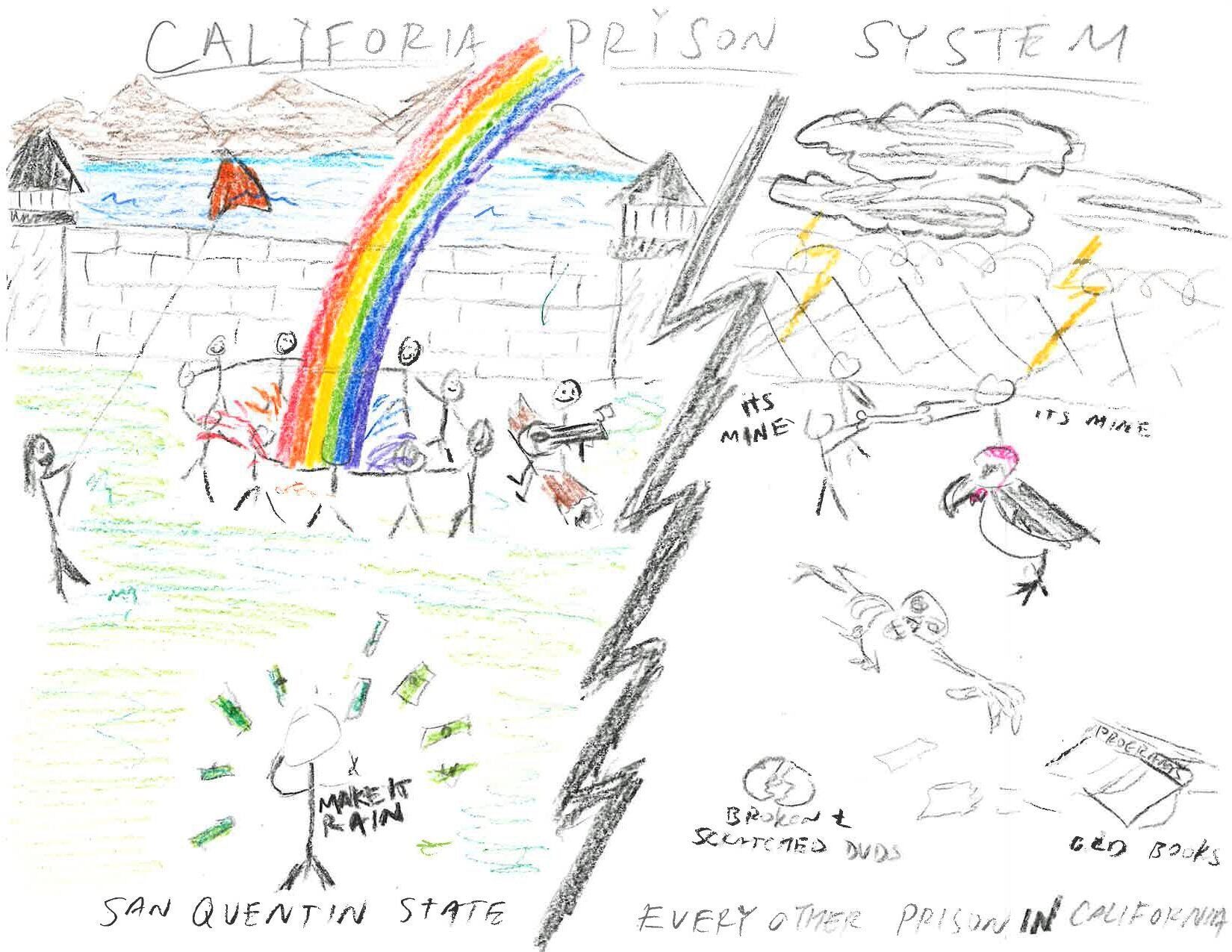
This artist says of the Learning Center that, “Besides San Quentin, prison resembles third world nations. Five computers with a class of twenty eight (Pelican Bay). Every month more inmates arrive, and our meal portions get that much smaller. As is the case in every prison, besides San Quentin.”1
The contrast between what is going on in the (rightly touted) new halls of San Quentin with carceral humanism (justice reforms of living conditions), and what actually goes on in the rest of the prison halls that get no publicity, is stark and real and needs to be seen and called out.
Because . . . propaganda.
Because . . . Martin is 80 years old and they beat him up. He may have been deemed a program failure to the Department. But to me, and to his incarcerated community, he is not a failure at all, but the very tall measure of a man.
Because . . . if an elderly gentleman who wanted to be at peace can be beaten so severely that he is shipped to a hospital and then to a prison medical facility where he will die, with no repercussions or consequences for those who beat him so severely, then this new “face” of Corrections is not much more than lipstick on a pig.

1 https://prisonerswithchildren.org/newspaper/california-prison-system/
Thank you for writing this Beth. Like Adam, I am left nearly speechless by reading about Martin. When will we learn how to treat every person with the respect they deserve? 💔
No words can convey what I feel after having read of Martin.